


Light | 復(fù)消色差X射線聚焦 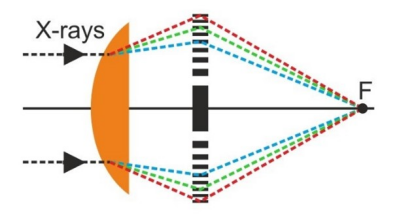
Apochromatic X-ray focusing. Light Sci Appl 12, 107 (2023).
2553 3 1
光與影 ??? 3年前
ZEMAX軟件技術(shù)應(yīng)用教程專題:將二進(jìn)制文件光源轉(zhuǎn)換為ASCII 
; /* Define the data structure for the ray information */typedef struct{float x, y, z;float l, m, n;float intensity;} FLUX_ONLY;typedef struct{float x, y, z; float l, m, n;float flux,
2166 1 1
w**elab86_Swsp ??? 3年前
光學(xué)設(shè)計(jì)技術(shù)基礎(chǔ)教程:Zemax與SPEOS光源文件格式 
對(duì)于僅通量格式的單色光源,光線結(jié)構(gòu)為:float x, y, z;float l, m, n;float flux;其中X、Y、Z表示光線位置,L、M、N表示光線方向,這與SPEOS光線數(shù)據(jù)中的相同,而Zemax光源文件中的光通量等效于SPEOS中的能量數(shù)據(jù)。
2529
w**elab86_Swsp ??? 3年前
散射方向關(guān)注的區(qū)域-重點(diǎn)采樣技術(shù) 
輸入在步驟3中確定的相應(yīng)的X,Y或Z最佳聚焦值(紅色箭頭8)。底部的光線規(guī)格(紅色箭頭13)必須設(shè)置為與圖7的最佳對(duì)焦對(duì)話框(紅色箭頭6)相同,以確保只移動(dòng)關(guān)注的元件上的光線。 圖10.用于將光線移動(dòng)到最佳焦點(diǎn)的實(shí)用程序 6)使用光線統(tǒng)計(jì)(Ray Statistics)(Shift + F12)打印“移動(dòng)”光線的最小/最大X、Y和Z值,如圖11所示。
1890
追光ing ??? 3年前
Moldex3D模流分析之使用Moldex3D解決高精度唇形表面困難成型的問題 
圖八為透過X-ray顯示產(chǎn)品真空泡的橫截面結(jié)果,該真空泡位置符合體積收縮率上限9%的模擬結(jié)果。因此,優(yōu)化的成型條件的過程中,應(yīng)確保其體積收縮率小于9%,才能獲得較高強(qiáng)度的產(chǎn)品。圖八 原始產(chǎn)品的X-ray掃描的真空泡結(jié)果(左圖)與體積收縮率9%以上的模擬結(jié)果(右圖)在保壓時(shí)間設(shè)定部分,產(chǎn)品的澆口處在14秒時(shí)已完全固化。
2267
Moldex3D 中國 ??? 3年前
FRED案例展示:重點(diǎn)采樣技術(shù)--散射方向關(guān)注的區(qū)域簡介 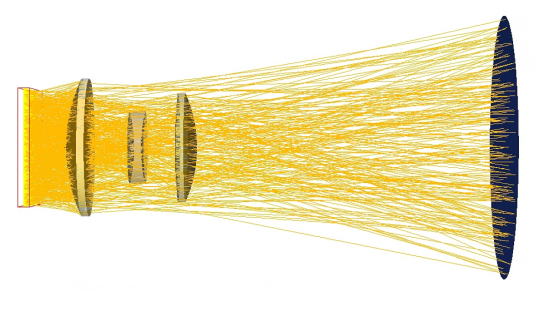
輸入在步驟3中確定的相應(yīng)的X,Y或Z最佳聚焦值(紅色箭頭8)。底部的光線規(guī)格(紅色箭頭13)必須設(shè)置為與圖7的最佳對(duì)焦對(duì)話框(紅色箭頭6)相同,以確保只移動(dòng)關(guān)注的元件上的光線。圖10:用于將光線移動(dòng)到最佳焦點(diǎn)的實(shí)用程序6)使用光線統(tǒng)計(jì)(Ray Statistics)(Shift + F12)輸出“移動(dòng)”光線的最小/最大X、Y和Z值,如圖11所示。這些值確定重點(diǎn)采樣的大小。
2314
追光ing ??? 1年前
SPEOS 與 Zemax 光源文件轉(zhuǎn)換器 
同樣也創(chuàng)建了一個(gè)矩形探測(cè)器 (Detector Rectangle),參數(shù)為 Z = 1mm、X Half Width = Y Half Width = 10 mm 以及 #X Pixel = #Y Pixel = 100。也將使得我們可以在 1mm 之外查看光源發(fā)出的光斑情況。
2578 1 1
w**elab86_Swsp ??? 3年前
Ansys Zemax / SPEOS | 光源文件轉(zhuǎn)換器 
同樣也創(chuàng)建了一個(gè)矩形探測(cè)器 (Detector Rectangle),參數(shù)為 Z = 1mm、X Half Width = Y Half Width = 10 mm 以及 #X Pixel = #Y Pixel = 100。也將使得我們可以在 1mm 之外查看光源發(fā)出的光斑情況。
2269
宇熠科技 ??? 3年前
VirtuaLab Fusion新版本:從光線光學(xué)到物理光學(xué)的無縫轉(zhuǎn)換 
它被稱為“Include Diffraction-Induced Contribution to Ray Direction”。光源模式衍射對(duì)光線方向有直接影響。有關(guān)更多信息請(qǐng)參閱用于光線追跡的光線的產(chǎn)生(Generation of Rays for Ray Tracing)。
1923
信光嗎 ??? 8月前
VirtuaLab Fusion新版本:從光線光學(xué)到物理光學(xué)的無縫轉(zhuǎn)換 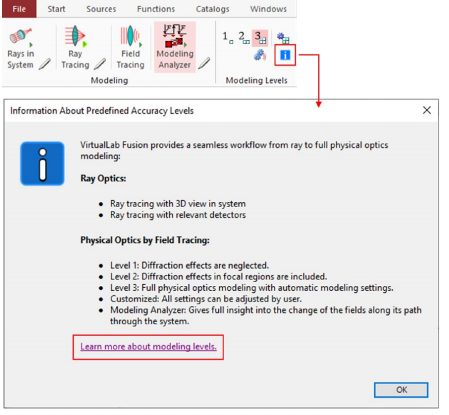
2.使用Rays in System來評(píng)估您的系統(tǒng)。這為您提供了第一個(gè)建模印象,并告訴你系統(tǒng)的配置是否正確合理。在這里,您也可以嘗試“Include Diffraction-Induced Contribution to Ray Direction”選項(xiàng)。3. 接下來執(zhí)行光線追跡(Ray Tracing)建模,獲得對(duì)系統(tǒng)行為的下一步了解,以及首次檢查探測(cè)器是否處于正確的位置。
2126
追光ing ??? 8月前
COMSOL Multiphysics在鋰離子電池中的應(yīng)用(下) 
例如,在電池電化學(xué)循環(huán)中,SEI/CEI組分的變化需要通過提取循環(huán)前后的樣品,并利用X射線光電子能譜技術(shù)(X-ray photoelectron spectroscopy, XPS)、X射線衍射(X-ray diffraction, XRD)、掃描電子顯微鏡(Scanning Electron Microscope, SEM)等測(cè)試手段來進(jìn)行表征。
3171 7
學(xué)時(shí)習(xí) ??? 2年前
VirtuaLab Fusion新版本:從光線光學(xué)到物理光學(xué)的無縫轉(zhuǎn)換 
2.使用Rays in System來評(píng)估您的系統(tǒng)。這為您提供了第一個(gè)建模印象,并告訴你系統(tǒng)的配置是否正確合理。在這里,您也可以嘗試“Include Diffraction-Induced Contribution to Ray Direction”選項(xiàng)。3. 接下來執(zhí)行光線追跡(Ray Tracing)建模,獲得對(duì)系統(tǒng)行為的下一步了解,以及首次檢查探測(cè)器是否處于正確的位置。
2193
追光ing ??? 2年前
VirtualLab Fusion:為光線追跡生成光線 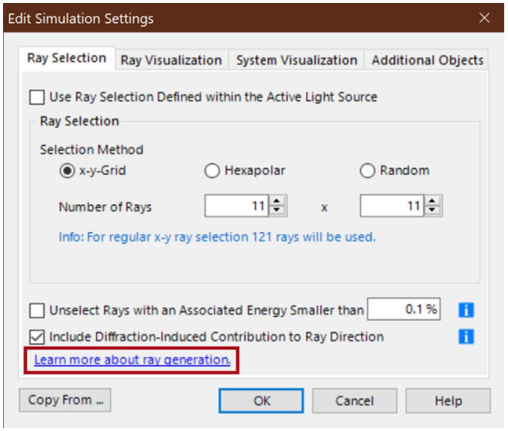
選擇“Unselect Rays with an Associated Energy Smaller Than x%”選項(xiàng),能量小于光源平面中最大光線能量x%的光線在計(jì)算中將被丟棄。
1718
追光ing ??? 9月前
VirtuaLab Fusion新版本:從光線光學(xué)到物理光學(xué)的無縫轉(zhuǎn)換
2.使用Rays in System來評(píng)估您的系統(tǒng)。這為您提供了第一個(gè)建模印象,并告訴你系統(tǒng)的配置是否正確合理。在這里,您也可以嘗試“Include Diffraction-Induced Contribution to Ray Direction”選項(xiàng)。3. 接下來執(zhí)行光線追跡(Ray Tracing)建模,獲得對(duì)系統(tǒng)行為的下一步了解,以及首次檢查探測(cè)器是否處于正確的位置。
2362
追光ing ??? 1年前
Ansys Zemax | 探索 OpticStudio中的序列模式 
打開幾何位圖圖像分析窗口,并如下圖所示對(duì)設(shè)置進(jìn)行修改:將輸入 (Input) 改為ALEX200.BMP,將像面上的X像素 (X Pixels) 和Y像素 (Y Pixels) 改為100,將X像素大小 (X Pixel Size) 和Y像素大小 (X Pixel Size) 改為0.5,然后增加追跡的光線數(shù)目,把光線/像素 (Rays/Pixel) 改為100,最后點(diǎn)擊確定。
2397
宇熠科技 ??? 8月前
FRED應(yīng)用說明:相干光模擬 
在圖14中紅色的X對(duì)應(yīng)于估計(jì)的條紋可見度,這是基于圖15所示的干涉圖樣。正如圖14和15所示,基于FRED模型的近似值合理的靠近理論值。 圖14 衍射儀的部分相干度vs小孔間距。點(diǎn)代表在FRED模型使用的設(shè)置處的理論 值。紅色X對(duì)應(yīng)于條紋可見度(等于 ),這是基于FRED圖(如圖15)計(jì)算得出。
2326 2
追光ing ??? 3年前
新一代光學(xué)工程仿真軟件—FRED MPC支持的功能 
目前僅支持一組有限的狀態(tài)屬性代碼,支持的狀態(tài)代碼為ray is halted, reason ray is halted, ray intersected, ray interacted, ray reflected, ray transmitted, scatter ray, specular ray, unresolvable material error, TIR error3.
2688
追光ing ??? 1年前
Ansys Speos | 擋風(fēng)玻璃光學(xué)畸變分析 
(第 106 行)默認(rèn)情況下,光線的起始位置的 X 坐標(biāo)設(shè)置為3500mm。如果用戶的擋風(fēng)玻璃的x坐標(biāo)位置大于3500mm,則用戶需要調(diào)整此值。10. (第 120 行)默認(rèn)情況下,所有 ray 文件都將在 C:\temp 文件夾下生成。如果用戶不存在此文件夾或希望保存在不同的位置,用戶可以自定義目標(biāo)生成文件夾。
2882
宇熠科技 ??? 1年前
VirtualLab Fusion:為光線追跡生成光線 
選擇“Unselect Rays with an Associated Energy Smaller Than x%”選項(xiàng),能量小于光源平面中最大光線能量x%的光線在計(jì)算中將被丟棄。
1155
信光嗎 ??? 9月前
ZEMAX | 探索 OpticStudio中的序列模式 
打開幾何位圖圖像分析窗口,并如下圖所示對(duì)設(shè)置進(jìn)行修改:將輸入 (Input) 改為ALEX200.BMP,將像面上的X像素 (X Pixels) 和Y像素 (Y Pixels) 改為100,將X像素大小 (X Pixel Size) 和Y像素大小 (X Pixel Size) 改為0.5,然后增加追跡的光線數(shù)目,把光線/像素 (Rays/Pixel) 改為100,最后點(diǎn)擊確定。
2378
宇熠科技 ??? 3年前
20條/頁 
 8
8 跳至頁


技術(shù)鄰APP
工程師必備
工程師必備
- 項(xiàng)目客服
- 培訓(xùn)客服
- 平臺(tái)客服
TOP
