1 垂直低音揚聲器陣列(Vertical Woofer Array)
它是一種在垂直方向上排列多個低音揚聲器單元的陣列。
2 水平低音揚聲器陣列(Horizontal Woofer Array)
它是一種在水平方向上排列多個低音揚聲器單元的陣列。
它是衡量揚聲器喇叭(Horn)的尺寸大小的參數(shù)。通常通過其口徑(直徑)來表示,單位常用英寸(inch)或毫米(mm)。
(1)小尺寸喇叭:通常具有口徑為幾英寸的小型喇叭,適用于便攜式音箱、汽車音響和低功率應(yīng)用。它們可以提供良好的高頻細(xì)節(jié)和定位精確度,但在低頻方面可能受限。
(2)中等尺寸喇叭:這些喇叭通常具有口徑在幾英寸到十幾英寸之間,并且適用于一般的家庭音響和商業(yè)應(yīng)用。它們可以提供更全面的頻率響應(yīng)和較高的音量輸出。
(3)大尺寸喇叭:大型喇叭通常具有更大的口徑(超過十幾英寸),在專業(yè)音響系統(tǒng)和大型場所中應(yīng)用廣泛。它們具有更高的功率處理能力、更低的低頻延遲和更高的聲壓級。
3.6.2 Vertical Woofer Arrays
3.6.2.1 Directivity at Frequencies Where Size Makes Horns Impractical
喇叭Horns的大小對頻率的指向性有一定影響(Horn的設(shè)計和參數(shù)還涉及到許多其他因素,例如角度、形狀、材料等,這些因素也會對指向性產(chǎn)生影響)。
(1)在低頻:大型喇叭對低頻具有較好的指向性控制。它們可以在較低的頻率范圍內(nèi)實現(xiàn)較為集中和定向的聲場覆蓋。它的振膜面積更大,能夠產(chǎn)生更強(qiáng)的輻射和壓力,從而實現(xiàn)更好的低頻指向性;而小型喇叭在低頻下的指向性控制相對較差。其輻射面積較小,無法產(chǎn)生足夠的壓力和輻射,導(dǎo)致低頻聲能更容易擴(kuò)散,使得低頻指向性較為寬松。
(2)高頻:大型喇叭在高頻下的指向性控制相對較差。由于高頻波長較短,它的出口尺寸與波長比較接近,難以實現(xiàn)準(zhǔn)確的指向性控制,容易出現(xiàn)較寬的擴(kuò)散和輻射;而小型喇叭在高頻下通常具有較好的指向性控制。其出口尺寸相對于波長來說較小,更容易實現(xiàn)較為準(zhǔn)確的指向性,并將聲能集中在狹窄的區(qū)域內(nèi)。
以下是Vertical Woofer Array和Horizontal Woofer Array各自的優(yōu)缺點,以及應(yīng)用策略對比圖(僅供參考)。
Beneficial destructive interference sounds like an oxymoron, but there are several commercially available woofer arrays that take advantage of this very technique. By applying the fundamental physics described by Harry Olson, directional woofer arrays are now available that outperform large woofer horns.
根據(jù)奧爾森的原理:當(dāng)兩個聲音的點源相互組合或疊加時,它們的輸出在所有方向上簡單地相加。這意味著每個點源的聲波相互疊加并共同向外傳播,導(dǎo)致聲音強(qiáng)度增加。
然而,隨著兩個點源之間距離的增加,會出現(xiàn)相位抵消的現(xiàn)象。在特定距離處,聲波的峰值和谷值以一種干涉破壞性方式對齊。這導(dǎo)致聲音強(qiáng)度降低,甚至在空間中的特定位置完全被抵消。在正好為半個波長(λ/2)的位置上,會產(chǎn)生純零點或完全抵消。這一點非常關(guān)鍵,因為它構(gòu)成了創(chuàng)建八字形或偶極子極性圖案的基礎(chǔ)。在這種極性圖案中,聲音強(qiáng)度集中在兩個相反的方向上,而在兩側(cè)被抵消。
通過理解這一原理,揚聲器設(shè)計師可以通過調(diào)整多個驅(qū)動器(如低音揚聲器)的間距和排列方式來創(chuàng)建定向聲音圖案,并控制聲能的傳播。正如前面提到的垂直低音揚聲器陣列,通過在垂直方向上間隔安排低音揚聲器,利用這一原理實現(xiàn)偶極子指向圖案。
Harry Olson is known for his contributions to the field of loudspeaker design and acoustics. One of his fundamental physics principles is related to interference and superposition of sound waves.
According to Olson's principle, when two point sources of sound are combined or superimposed on each other, their outputs simply add up in all directions. This means that the sound waves from each point source combine and propagate outward together, resulting in an increase in sound intensity.
However, as the distance between the two point sources increases, a phenomenon called phase cancellation occurs. At certain distances, the peaks and troughs of the sound waves align in such a way that they interfere destructively with each other. This results in a decrease in sound intensity or even complete cancellation at specific locations in space.
At exactly half a wavelength (λ/2), a pure null or cancellation occurs. This specific point is crucial because it forms the basis for creating directional sound patterns like the figure 8 or dipole polar pattern. In this polar pattern, the sound intensity is concentrated in two opposite directions while canceling out at the sides.
By understanding this principle, loudspeaker designers can manipulate the spacing and arrangement of multiple drivers (such as woofers) to create directional sound patterns and control the dispersion of sound energy. Vertical woofer arrays, as mentioned earlier, take advantage of this principle by spacing the woofers in a vertical configuration to achieve dipolar patterns.
Olson's work and understanding of interference and superposition have greatly influenced the design and development of loudspeakers, allowing for improved directivity and control over the sound field. His principles continue to be relevant in the field of acoustics and speaker system design today.
When two point sources are superimposed on one another, their outputs simply add up in all directions. As the two point sources are spread apart, the output diminishes along the plane of separation due to phase cancellation. At exactly ? wavelength, a pure null occurs, and we achieve the classic figure 8, dipole polar pattern. The current commercially available systems take advantage of this phenomena, directivity through off-axis attenuation, by placing woofers in a vertical array and spacing them to create this dipolar pattern at frequencies below which horns become too large.
Tri-Polar設(shè)計包括兩個側(cè)面揚聲器單元和一個中央揚聲器單元。側(cè)面揚聲器單元位于主要聽眾位置的兩側(cè),而中央揚聲器位于主要聽眾位置正前方。每個揚聲器單元都有自己的驅(qū)動器或陣列,以產(chǎn)生特定方向的聲場。
它旨在提供更廣泛的聲場覆蓋,并創(chuàng)造出一種環(huán)繞效果,使聽眾感受到來自多個方向的聲音。通過將聲音從兩側(cè)和中央投射出來,它可以提供更加沉浸式的音頻體驗,特別適合用于家庭影院系統(tǒng)或多媒體娛樂環(huán)境。
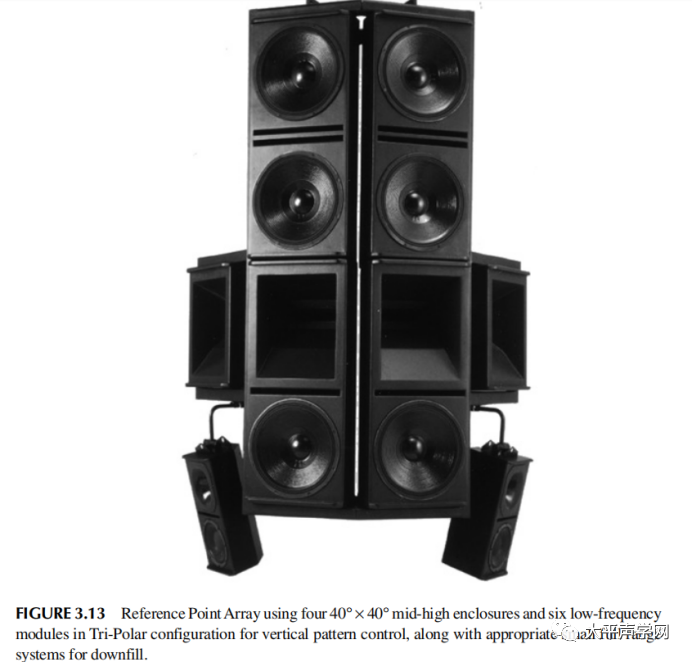
Figure 3.13 is an example of one such array. Termed Tri-Polar by its designer Vance Breshears, it uses the vertical spacing between the three woofers with appropriate signal processing to maintain consistent low-frequency pattern control from 400Hz down to below 100Hz. One of the first systems available was developed by Craig Janssen, termed Tuned Dipolar, which uses two separate arrays. With drivers, spacing, and signal processing appropriate for their respective passbands Tuned Dipolar offers exceptional low-frequency pattern control over an extended bandwidth. Even subwoofers are now benefitting from this type of technology. Meyer Sound is achieving cardioid patterns at lowest frequencies from its PSW?6, providing significant attenuation of those frequencies directly behind the enclosures.
下圖是Bi-Polar、Dipole和Termed Tri-Polar的各自優(yōu)缺點和使用策略對比圖(僅供參考):
揚聲器布局類型
|
Bi-Polar
|
Dipole
|
Termed Tri-Polar
|
定義
|
揚聲器配置包括兩個相同的揚聲器單元,這些單元背對背地放置在一個共享的箱體中。
|
揚聲器配置包括兩個背對背的揚聲器單元,其振膜面向前方和后方輻射聲音。
|
揚聲器配置包括三個揚聲器單元,兩個側(cè)面揚聲器和一個中央揚聲器。
|
優(yōu)點
|
1擴(kuò)散性好:Bi-Polar設(shè)計通過向前后兩個方向輻射聲音,可以提供更廣泛的聲場分布,創(chuàng)造出一種環(huán)繞感。
2立體感強(qiáng):由于揚聲器單元背對背放置,聲音也會反射并與側(cè)墻或后墻發(fā)生交互作用,增加了立體感和空間感。
|
1廣泛的聲場覆蓋:Dipole設(shè)計創(chuàng)造出一種類似于開放空間的聲學(xué)環(huán)境,能夠產(chǎn)生更廣泛、自然的聲場分布。
2適合環(huán)繞聲:由于不直接輻射到前方聽眾,Dipole揚聲器常用于環(huán)繞聲頻道,提供沉浸式的環(huán)繞聲音效。
|
1廣泛的聲場分布:通過將聲音從兩側(cè)和中央投射出來,Tri-Polar設(shè)計可以提供更廣泛的聲場覆蓋和沉浸式的音頻體驗。
2多方向指向性:Tri-Polar設(shè)計允許在前方和兩側(cè)產(chǎn)生不同的指向性模式,增加音頻表現(xiàn)的靈活性。
|
缺點
|
相干性差:由于背對背放置的揚聲器單元之間缺乏相位一致性,可能導(dǎo)致頻率響應(yīng)不均勻或出現(xiàn)干涉現(xiàn)象。
|
1低頻響應(yīng)受限:Dipole揚聲器在低頻范圍內(nèi)的輸出會受到前后相位抵消的影響,導(dǎo)致低頻響應(yīng)有所下降。
2需要特殊的房間布局:由于Dipole揚聲器的聲場特性,對房間的反射和吸收要求較高,需要考慮房間的聲學(xué)狀況。
|
1空間需求較大:由于將三個揚聲器單元放置在一起,Tri-Polar設(shè)計可能需要更大的空間來適應(yīng)這種布局。
2需要精細(xì)調(diào)整:為了獲得最佳性能,Tri-Polar揚聲器系統(tǒng)需要進(jìn)行仔細(xì)調(diào)整和校準(zhǔn),以確保每個揚聲器單元之間的相位一致性和協(xié)調(diào)性。
|
使用策略
|
適用于家庭影院系統(tǒng)或多媒體娛樂環(huán)境,可以為聽眾提供沉浸式的環(huán)繞聲音體驗。然而,在良好的房間布局和調(diào)整中,需要注意解決相干性和均衡性的問題。
|
通常用于環(huán)繞聲系統(tǒng)或多聲道音響系統(tǒng)中,為聽眾提供真實感和沉浸感。它們適用于大型家庭影院、錄音室等需要環(huán)繞聲效果的場所。
|
用于家庭影院系統(tǒng)或多媒體娛樂環(huán)境中,特別適合那些希望實現(xiàn)全方位聲音分布和沉浸式體驗的用戶。它們可以提供覆蓋更廣泛的聽音區(qū)域,并允許通過調(diào)整各個揚聲器單元來滿足特定的聲場需求。
|
【Reference】
《Electroacoustic Devices: Microphones and Loudspeakers》Edited by Glen Ballou
【免責(zé)聲明】
推文引用的資料大部分來源于網(wǎng)絡(luò)和書籍,推文的目的僅僅在于交流學(xué)習(xí)分享知識,并不意味著贊成和反對,且不為其版權(quán)負(fù)責(zé)。如涉及侵權(quán),請及時聯(lián)系我刪除。
文章來源:大平聲學(xué)網(wǎng)


